
Quantum in the Classroom: Educator Profiles
Meet Vryann Sison, Hardin High School
By Rebekah Yager, SMRC education and workforce development intern
Each year on April 14, the celebration of World Quantum Day (WQD) promotes international public awareness and understanding of quantum science and technology– a field that seems incomprehensible to many. In honor of this day and effort, MSU’s Science Math Resource Center (SMRC), which leads quantum education and workforce development for Montana State University’s QCORE, sent out quantum kits to rural Montana schools so students and teachers could learn about quantum concepts and the quantum research taking place in Montana.
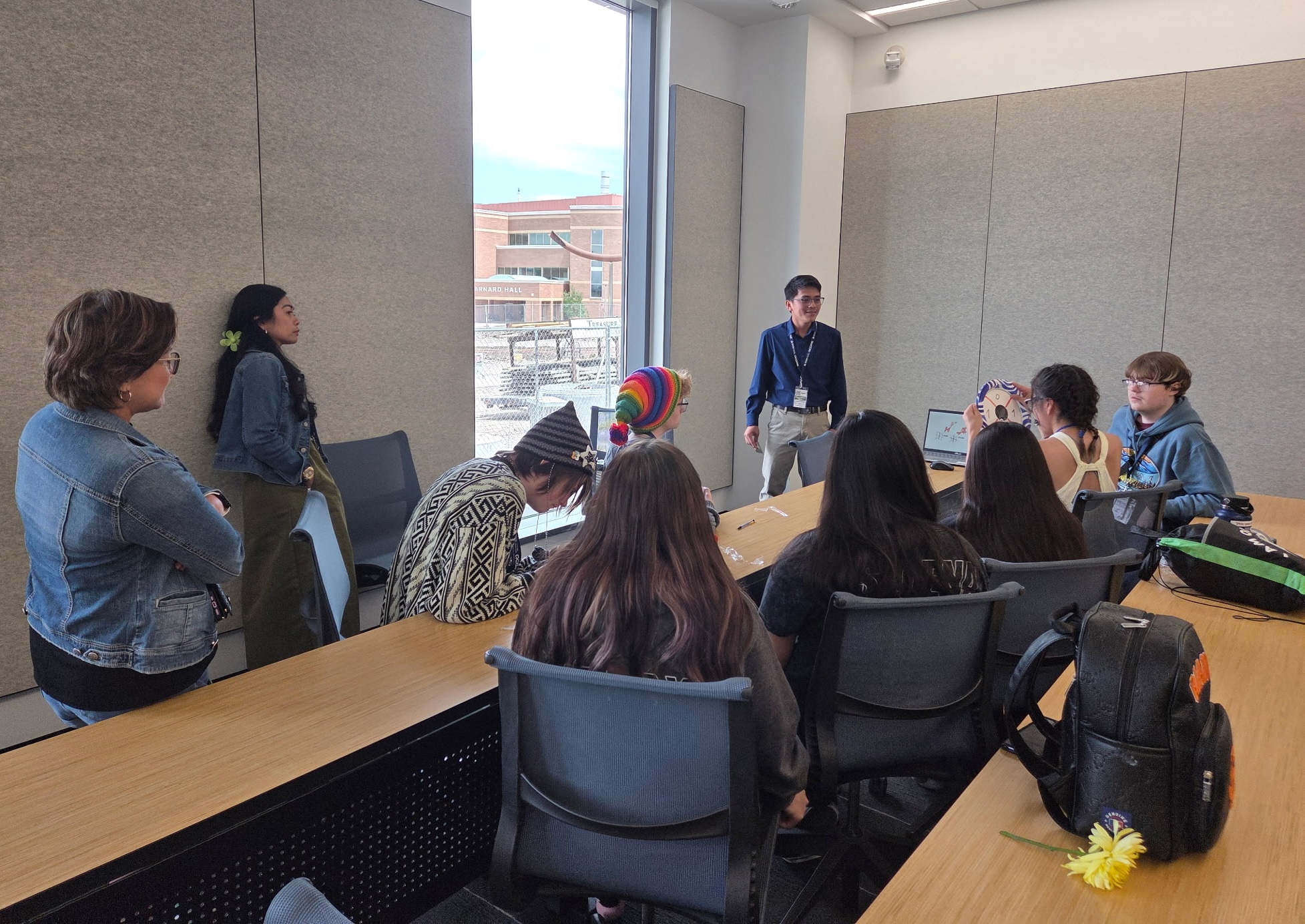 The kits introduced quantum themes using four hands-on activities: a three-polarizer
demo (first shared with SMRC by the MSU Optics & Photonics student society); and thaumatropes, Exploring Spectra and electron transitions – activities that are
featured on the National Q-12 Education Partnership's QuanTime Website. An expansion pack for teachers who had earlier received the 2024 WQD kit
included the three-polarizer demo and a 2D materials/graphene activity based on 2D
quantum materials research currently underway at Montana State University.
The kits introduced quantum themes using four hands-on activities: a three-polarizer
demo (first shared with SMRC by the MSU Optics & Photonics student society); and thaumatropes, Exploring Spectra and electron transitions – activities that are
featured on the National Q-12 Education Partnership's QuanTime Website. An expansion pack for teachers who had earlier received the 2024 WQD kit
included the three-polarizer demo and a 2D materials/graphene activity based on 2D
quantum materials research currently underway at Montana State University.
To see the impact of these materials firsthand, we spoke with Vryann James L. Sison, a science educator who used both the core and expansion kits in his classrooms. Vryann, part of a teacher exchange program from the Philippines, taught at Fromberg Public Schools in 2023 before moving to Hardin High School, where he now teaches science. Hardin is a town of just under 4,000 people located in southeastern Montana, adjacent to the Crow Reservation. Vryann was originally a participant in the Nanoscience Summer Institute for Middle School Teachers, NanoSIMST, through which he learned about quantum opportunities at Montana State University.
"To be honest, I don't like physics.....and then quantum things, it's not my thing,” Vryann laughed, “My background is in biology, or biological science, so I don't have any idea what those quantum things are, but I enjoyed it, and then I started to see quantum in every day. Like, ‘this one is quantum, this one is quantum,’ and then quantum is everywhere. It can be in biology, it can be in physics, in chemistry.”
Vyrann said that the Exploring Spectra demo was a huge success with his high school class. They liked the lights – especially the UV one. Vryann supplemented the kit with paints, both regular and luminescent. “Then (the students) don't know that it's gonna glow afterwards, and then we just post it on the wall, and then, I gave them the UV light, and then they're like, ‘wow, it's glowing, Mr. Sison,’ so I was like, yeah.”
Polarization was also a hit. “One student said, ‘What kind of voodoo magic is that?’” Vryann shared. The students loved the hands-on approach – through learning by doing. The hands-on nature of the demos made the more difficult and abstract topics click. “They understood it themselves – step by step. If I started with a lecture, it was just ‘blah, blah, blah’ to them,” said Vryann.
Since participating in World Quantum Day, Vryann has jumped into the deep end of the quantum pool. He attended Quantum Summer Academy at MSU, which partnered with Sandia National Laboratory’s QCaMP to provide a week’s worth of quantum activities for teachers alongside a summer academy for high school students.
Vryann then presented about his experiences teaching quantum to fellow educators at the STEM Summer Institute in Bozeman in July, then served on a workforce development panel at QCORE’s launch week in Augustn 2025.
Looking ahead, Vryann plans to integrate the quantum kits into his curriculum more deeply, with the support of his fellow science teachers. He also hopes to expand quantum concepts into subjects beyond physics and chemistry.
“Because, to be honest, quantum is more inclined to physics and chemistry,” said Vryann. “But I would like to do it in my other classes, like biology.”
Vryann is also excited to extend this learning and training to kids from his own country. One of his requirements for teaching in the U.S. is to have an exchange of culture. He believes having a collaboration on quantum learning and activities would be a great opportunity to exchange richness of culture from the East and West. He said people in the Philippines view quantum differently, so he believes that connecting schools to discuss quantum would be a success.
As quantum science reshapes technology, medicine, and communication, it’s critical that students of all backgrounds get the chance to engage with it early. Thanks to passionate teachers like Vryann and resources from programs like QCORE and SMRC, the next generation won’t just learn quantum, they’ll lead it.
Posted December 2025