

MSU Exposure Control Plan - For Research Laboratories
Updated 12/2025
Biosafety Officer: Amy Robison, amanda.robison@montana.edu (406) 994-6733MSU Research Integrity & Compliance
Table of Contents
Program Administration and Responibilities
Department/Designated Department Contact Responsibilities
OSHA Bloodborne Pathogens Defiinitions
Engineering Controls and Work Practices
Exposure Control Item and Work Practice List
Personsal Protective Equipment
PPE to be Used and Associated Task List
Post-Exposure Evaluation and Follow-Up
Administration of Post-Exposure Evaluation & Follow-up
Post Exposure Incident Procedures
Appendix E: Additional Resources
Post Exposure Incident Procedures
Policy
Montana State University (MSU) is committed to providing a safe working environment where employees can perform their duties without the risk of injury or illness. In pursuit of this endeavor, the following Exposure Control Plan (ECP) has been established to eliminate or minimize occupational exposure to bloodborne pathogens in alignment with OSHA standard 29 CFR 1910.1030 - Occupational Exposure to Bloodborne Pathogens.
Exposure Control Plan includes:
- Bloodborne Pathogens Program and Exposure Control Plan administration.
- Department responsibilities.
- Determination of employee exposure.
- Implementation of various methods of exposure control, including:
- Universal Precautions.
- Engineering and work practice controls.
- Personal Protective Equipment.
- Housekeeping
- Hepatitis B vaccination.
- Post-exposure evaluation and follow-up.
- Communication of hazards to employees and training.
- Recordkeeping
- Procedures for evaluating circumstances surrounding an exposure incident.
The Exposure Control Plan aligns with the requirements of OSHA 1910.1030 and may assist MSU in implementing and complying with this standard.
Scope
This policy applies to the following research laboratory personnel:
- All paid employees with occupational exposure to human blood or other potentially infectious materials (OPIM).
All non-paid personnel (students, interns, volunteers) who perform tasks in MSU research laboratories with potential exposure to human blood or OPIM as part of their education, placement or training at MSU, see Appendix F of this ECP.
Program Administration and Responsibilities
The MSU Exposure Control Plan provided by Safety and Risk Management will be reviewed at least annually and updated, as needed by:
- Safety and Risk Management (SRM).
- Environmental Safety and Health (ESH) Committee.
The Department and/or Designated Department Contact will review their specific Exposure Control Plan annually and update as needed.
Department/Designated Department Contact Responsibilities
Department/Designated Department Contact (supervisor, manager, director, and/or principal investigator) is responsible for identifying employees who may have exposure to bloodborne pathogens or Other Potentially Infectious Materials (OPIM), as defined by OSHA standard 1910.1030 while conducting their assigned work activities/job tasks and meeting Exposure Control Plan responsibilities. Until the Department/Designated Department completes the Items of Attention, your specific Exposure Control Plan is not complete and may not meet requirements of OSHA 1910.1030.
Departments that have employees who are determined to have occupational exposure to blood or OPIM are responsible for reviewing the and completing/executing the ECP specific to their department including the following:
- Maintenance, review, and updating of the ECP specific to their department.
- Reviewing the ECP for their department at least annually, whenever new procedures or tasks are added, and/or if the general scope of work changes.
- Providing personnel with the required personal protective equipment (PPE), engineering controls, labels, and other items required under this plan.
- Ensuring their personnel who have occupational exposure to blood or OPIM adhere to the procedures and work practices outlined in this plan.
- Ensuring that adequate supplies of equipment are available to employees.
- Ensuring that all medical actions required by the standard are performed and that appropriate health and OSHA records are maintained.
- Providing work-specific training, documentation of training, and ensuring that the ECP is available to personnel, Safety and Risk Management, the BSO, OSHA/Department of Labor (DLI), and other regulatory representatives.
- Offering the hepatitis B vaccination to workers with potential for exposure to blood or OPIM before starting work with these materials and maintaining documentation of this offer.
| Department or Laboratory Location | Designated Department Contact | Phone Number | |
| Research Integrity and Compliance, Lewis Hall 101 | Biosafety Officer, Amy Robison | 406-994-6733 | amanda.robison@montana.edu |
Employees
Employees who are determined to have occupational exposure to bloodborne pathogens or OPIM are responsible for following the ECP and established work procedures.
OSHA Bloodborne Pathogens Definitions
The following definitions are as provided by OSHA in 29 CFR 1910.1030.
- Assistant Secretary means the Assistant Secretary of Labor for Occupational Safety and Health or designated representative.
- Blood means human blood, human blood components, and products made from human blood.
- Bloodborne Pathogens means pathogenic microorganisms that are present in human blood and can cause disease in humans. These pathogens include, but are not limited to, hepatitis B virus (HBV) and human immunodeficiency virus (HIV).
- Clinical Laboratory means a workplace where diagnostic or other screening procedures are performed on blood or other potentially infectious materials.
- Contaminated means the presence or the reasonably anticipated presence of blood or other potentially infectious materials on an item or surface.
- Contaminated Laundry means laundry which has been soiled with blood or other potentially infectious materials or may contain sharps.
- Contaminated Sharps means any contaminated object that can penetrate the skin including, but not limited to, needles, scalpels, broken glass, broken capillary tubes, and exposed ends of dental wires.
- Decontamination means the use of physical or chemical means to remove, inactivate, or destroy bloodborne pathogens on a surface or item to the point where they are no longer capable of transmitting infectious particles and the surface or item is rendered safe for handling, use, or disposal.
- Director means the Director of the National Institute for Occupational Safety and Health, U.S. Department of Health and Human Services, or designated representative.
- Engineering controls mean controls (e.g., sharps disposal containers, self-sheathing needles, safer medical devices, such as sharps with engineered sharps injury protections and needleless systems) that isolate or remove the bloodborne pathogens hazard from the workplace.
- Exposure Incident means a specific eye, mouth, other mucous membrane, non-intact skin, or parenteral contact with blood or other potentially infectious materials that results from the performance of an employee's duties.
- Handwashing facilities means a facility providing an adequate supply of running potable water, soap, and single-use towels or air-drying machines.
- Licensed Healthcare Professional is a person whose legally permitted scope of practice allows him or her to independently perform the activities required by the OSHA Bloodborne Pathogen standard – 29 CFR 1910.1030.
- HBV means hepatitis B virus.
- HIV means human immunodeficiency virus.
- Needleless systems means a device that does not use needles for:
- The collection of bodily fluids or withdrawal of body fluids after initial venous or arterial access is established;
- The administration of medication or fluids; or
- Any other procedure involving the potential for occupational exposure to bloodborne pathogens due to percutaneous injuries from contaminated sharps.
- Occupational Exposure means reasonably anticipated skin, eye, mucous membrane, or parenteral contact with blood or other potentially infectious materials that may result from the performance of an employee's duties.
- Other Potentially Infectious Materials (OPIM) means:
- The following human body fluids: semen, vaginal secretions, cerebrospinal fluid, synovial fluid, pleural fluid, pericardial fluid, peritoneal fluid, amniotic fluid, saliva in dental procedures, any body fluid that is visibly contaminated with blood, and all body fluids in situations where it is difficult or impossible to differentiate between body fluids;
- Any unfixed tissue or organ (other than intact skin) from a human (living or dead); and
- HIV-containing cell or tissue cultures, organ cultures, and HIV- or HBV-containing culture medium or other solutions; and blood, organs, or other tissues from experimental animals infected with HIV or HBV.
- Parenteral means piercing mucous membranes or the skin barrier through such events as needlesticks, human bites, cuts, and abrasions.
- Personal Protective Equipment is specialized clothing or equipment worn by an employee for protection against a hazard. General work clothes (e.g., uniforms, pants, shirts, or blouses) not intended to function as protection against a hazard are not considered to be personal protective equipment.
- Production Facility means a facility engaged in industrial-scale, large-volume or high concentration production of HIV or HBV. There are currently no HIV or HBV production facilities at MSU.
- Regulated Waste means liquid or semi-liquid blood or other potentially infectious materials; contaminated items that would release blood or other potentially infectious materials in a liquid or semi-liquid state if compressed; items that are caked with dried blood or other potentially infectious materials and are capable of releasing these materials during handling; contaminated sharps; and pathological and microbiological wastes containing blood or other potentially infectious materials.
- Research Laboratory means a laboratory producing or using research-laboratory-scale amounts of HIV or HBV. Research laboratories may produce high concentrations of HIV or HBV but not in the volume found in production facilities.
- Sharps with engineered sharps injury protections means a non-needle sharp or a needle device used for withdrawing body fluids, accessing a vein or artery, or administering medications or other fluids, with a built-in safety feature or mechanism that effectively reduces the risk of an exposure incident.
- Source Individual means any individual, living or dead, whose blood or other potentially infectious materials may be a source of occupational exposure to the employee. Examples include, but are not limited to, hospital and clinic patients; clients in institutions for the developmentally disabled; trauma victims; clients of drug and alcohol treatment facilities; residents of hospices and nursing homes; human remains; and individuals who donate or sell blood or blood components.
- Sterilize means the use of a physical or chemical procedure to destroy all microbial life including highly resistant bacterial endospores.
- Universal Precautions is an approach to infection control. According to the concept of Universal Precautions, all human blood and certain human body fluids are treated as if known to be infectious for HIV, HBV, and other bloodborne pathogens.
- Work Practice Controls means controls that reduce the likelihood of exposure by altering the manner in which a task is performed (e.g., prohibiting recapping of needles by a two-handed technique).
Exposure Risk Determination
The Exposure Risk Determination List is a list of job titles with tasks where there is a reasonable anticipation of exposure to blood and/or OPIM in the course of their MSU job duties.
OSHA defines Occupational Exposure as reasonably anticipated skin, eye, mucous membrane, or parenteral contact with blood or other potentially infectious materials that may result from the performance of an employee's duties.
Part-time, temporary, contract, and per diem employeesarecovered by the standard.
Research and non-research settings should be considered as applicable:
- Research settings: laboratories, animal research, and clinical research.
- Non-research settings: facility services, athletics, student health services, campus police, and auxiliary services.
| Job Title/Classification | Department/Location | Task/Procedure |
| Researcher | Research/Laboratory | Personnel working with or conducting research on human blood, OPIMs, unfixed human tissues and organs, and/or cultures derived from human cells/tissues, or experimental animals infected with BBP |
| Phlebotomist | Research/Laboratory | Drawing blood, handling samples |
| Animal Care Technicians | Animal Resources Center | Handling animals or samples infected with BBP |
Methods of Expose Control
Universal Precautions
All persons who fall under this ECP will utilize universal precautions, which is the concept treating all human blood and certain human body fluids as if known to be infectious for HIV, HBV, and other bloodborne pathogens.
Exposure Control Plan
The ECP outlines measures for evaluating potential exposure to blood and OPIM, as well as methods of eliminating or reducing the risk of exposure.
Persons covered by the OSHA bloodborne pathogen standard receive an explanation of the ECP during their initial training. Controls outlined within this plan will also be reviewed in the annual refresher training.
All persons can review this plan at any time during their work shifts by contacting their Designated Department Contact. A printed copy of the ECP is available, without charge, within 15 days of request through Designated Department Contact. Additional assistance may be requested through Safety and Risk Management (non-research settings) and/or the BSO (research settings).
Engineering Controls and Work Practices
An engineering control is any equipment or structure that is used to aid staff in preventing exposure to blood or other potentially infectious materials. Work practices may also be used to reduce exposure by modifying how employees’ complete tasks. Please also see OSHA Definitions.
Examples of these controls include:
- Handwashing facilities which are readily accessible to employees.
- When handwashing facilities is not feasible, either an appropriate antiseptic hand cleanser in conjunction with clean cloth/paper towels or antiseptic towelettes are provided. When antiseptic hand cleansers or towelettes are used, hands will be washed with soap and running water as soon as feasible.
- Employees wash their hands immediately or as soon as feasible after removal of gloves or other personal protective equipment, before leaving the work area, and at the end of their workday.
- Employees wash hands and any other skin with soap and water, or flush mucous membranes with water immediately or as soon as feasible following contact of such body areas with blood or other potentially infectious materials.
- Contaminated needles and other contaminated sharps are not bent, sheared, or recapped.
- Sharps are only disposed of in a closeable, hard-walled, puncture-resistant, and labeled sharps container.
- Eating, drinking, smoking, applying cosmetics or lip balm, and handling contact lenses are prohibited in work areas where there is a reasonable likelihood of occupational exposure.
- Food and drink are not kept in refrigerators, freezers, shelves, cabinets, or on countertops or benchtops where blood or other potentially infectious materials may be present.
- All procedures involving blood or other potentially infectious materials are performed in such a manner as to minimize splashing, spraying, spattering, and generation of droplets of these substances.
- Mouth pipetting/suctioning of blood or other potentially infectious materials is prohibited.
- Mechanical means are used for handling potentially blood-contaminated/OPIM contaminated broken glass and/or sharps (such as forceps, tongs, or a broom and dustpan.
- Contaminated items or equipment used to store, transport, or process blood/OPIM is labeled with a biohazard label – see Labels section of ECP.
- Surfaces and equipment are decontaminated with an appropriate disinfectant and the disinfectant type/procedure is recorded in the Exposure Control Items and Work Practices List, minimally at the end of the workday and whenever contamination is obvious.
- Equipment or locations which may be reasonably anticipated to be contaminated with blood/OPIM are cleaned and decontaminated before servicing. Complete the Equipment Decontamination Certificate and affix it to the decontaminated equipment.
- The practice of Universal Precautions as defined by OSHA is utilized – see OSHA Definitions section.
Exposure Control Item and Work Practice List
Name the item or work practice you will use to minimize your chances of exposure to blood and OPIM. Identify specific equipment or practices to reduce exposure based on the task listed in the Exposure Risk Determination List.
HIV and HBV research laboratories have additional controls required under OSHA BBP standard (1910.1030(e)(3)).
| Item/Practice | Description |
| Tongs, forceps, or broom and dustpan | Use to pick up broken biologically contaminated glass or sharps. |
| Sharps engineered for safer use (ex.: retractable needles, self-sheathing scalpel blades, needle guards, needle-less delivery systems) | Use when administering injectable material to humans or animals; during necropsy. It is vitally important that the use of these devices becomes standard practice in research laboratories. Employees who use these devices the most are consulted for input in the type of sharps engineered for safer use. See the MSU Policy: Working with Sharps, for more information. |
| Retractable blood collection sets | Use when collecting blood from humans. |
| Blood collection tube holder | Use when collecting blood from humans. |
| Biosafety cabinet (BSC) | Use to protect against biological aerosols/droplets when culturing human cells and BBPs. Ensure the BSC is functioning properly before use, including the blower and alarm are turned on, the sash is opened to the proper height, check the magnehelic gauge is in range of the certification sticker (or check the digital display indicates the blower is on for those BSCs without a magnehelic gauge), and check inward airflow at the sash opening with a tissue. Disinfect BSCs before and after use. BSCs must be certified annually and after they are moved. |
| Leak-proof, non-breakable containers | Use leak-proof, non-breakable containers to collect and store human materials. Plasticware is substituted for glassware whenever possible. Containers used for holding, processing or transporting human materials shall be labeled as biohazards |
| Centrifuge safety cups | Use lids fitted with gaskets on centrifuge rotor buckets to contain aerosols should a tube break during centrifugation. Clean and lubricate gaskets regularly, inspect for cracks before each use, as replace as necessary. Disinfect equipment after use. |
| Sharps containers | Use in the immediate work area to properly dispose of all sharps (i.e., needles, lancets, razor/scalpel blades, Pasteur pipettes, glass capillary tubes). When contents reach the “full line”, seal, autoclave, and dispose of the container via the SRM Waste Pick-up Form. |
| Sink for hand washing | Use a dedicated sink (consisting of hot and cold running water, soap and towels) for hand washing. Employees must wash their hands and any other potentially contaminated skin area after remove gloves or other PPE. If a hand washing sink is not immediately available, a 60-95% alcohol-based hand sanitizer should be used and the employee should wash their hands as soon as possible. |
| Eye wash stations | Use in the event of an ocular exposure. Ensure the eye wash station is tested and documented weekly. |
| Disinfection | Use 70% ethanol or 10% bleach to surface disinfect the outside of samples or equipment after use or equipment that needs servicing/disposal; Use a final concentration of 10% bleach for 30 minutes at room temperature to decontaminate human cell cultures, blood, OPIM, etc., then they may be poured down the drain and flushed with ample amounts of water. Due to the large amount of protein present, blood is not a good candidate for autoclaving and should be treated with bleach. |
| Sterilization | Autoclave potentially contaminated materials using a validated autoclave. Cycle parameters are a minimum of 121oC for 60 minutes. |
| Inactivation | Use methods described in your IBC protocol and/or lab-specific SOPs. |
Personal Protection Equipment
Personal Protective Equipment is the last layer of protection from exposure to blood or OPIM. The Department/Designated Department Contact is responsible for ensuring PPE is appropriate for reducing the risk of exposure, purchased, available for use during the work shift, and replaced as needed.
The Principal Investigator/supervisor is responsible for supplying PPE, and ensuring employees using PPE are familiar with and observe the precautions below.
- Wash hands immediately after removing gloves and other PPE.
- Remove and replace PPE after it becomes contaminated and remove it completely before leaving the work area.
- All used, disposable PPE that is contaminated or potentially contaminated is placed in the appropriate biowaste containers.
- Wear gloves when there may be hand contact with blood and/or OPIM or contaminated items/surfaces.
- Replace gloves if they are torn, punctured, or contaminated, or if their ability to function as a barrier is compromised; wash hands before putting on a new pair.
- Never wash or decontaminate disposable PPE for reuse.
- Wear appropriate face and eye protection when procedures may generate splashes, sprays, spatters, or droplets of blood and/or OPIM.
- Remove any garments that have been contaminated with blood and/or OPIM as soon as possible.
- Reusable PPE, such as protective eyewear or face shields, are wiped down with an appropriate disinfectant following use.
- Reusable cloth PPE will follow the ECP Laundering section.
PPE to be Used and Associated Task List
| PPE to be Used | Associated Tasks |
| Disposable gloves | Wear whenever handling human materials |
| Lab coat | Wear whenever handling human materials |
| Safety glasses | Use when there is a splash hazard |
| Goggles, shoe covers, respiratory protection | Use, if necessary, when cleaning a spill, in addition to a lab coat and disposable gloves |
Housekeeping
Regulated Waste
Regulated waste is placed in containers that are: closable, constructed to contain all contents and prevent leakage, appropriately labeled or color-coded, and closed before removal to prevent spillage or protrusion of contents during handling.
Sharps
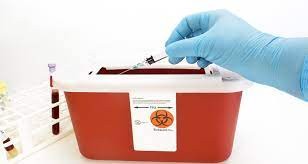
Needles, scaffolds, lancets, slides, coverslips, glass pipettes, capillary tubes, broken glass, or similar sharp material potentially contaminated with blood and/or OPIM are collected in appropriately labeled, closeable, hard-walled, and puncture-resistant containers.
Waste Containers
Waste containers are conveniently located near the areas where work is being performed. If your job only sporadically involves potential contact with blood and/or OPIM, you may need to request these containers. Please visit the Safety and Risk Management website Hazardous Waste section for additional information on:
- Regulated waste.
- Sharps
- Waste container/to request waste containers.
- To request a waste assessment and/or to request a waste pickup.
Safety and Risk Management is notified if regulated waste containers, refrigerators containing blood or OPIM, contaminated equipment, or other potentially contaminated/unknown materials are discovered on campus by submitting a Safety Concern Form.
Laundering
If reusable/cloth PPE is used when working with BBP/OPIM:
- Laundering service will be done by trained personnel – on or off campus.
- All contaminated laundry is handled as little as possible with minimal agitation and placed in appropriately labeled, leak-proof containers before transporting for laundering.
- Appropriate PPE is used when handling and/or sorting contaminated laundry.
Laundering Service facility/phone/contact information:
Potentially contaminated clothing, including lab coats or personal clothing (in the case of a spill getting on personal clothes), must be decontaminated prior to laundering. Handle contaminated laundry as little as possible, with minimal agitation. Place contaminated items in a biohazard bag and autoclave. Utilize either MSU-owned washer/dryer, or use a local commercial laundry service. Use of personal washer/dryer (i.e., home, dorm) is strictly prohibited.
Labels & Signs
Warning labels are affixed to containers of regulated waste, refrigerators and freezers containing blood/OPIM and other containers used to store, transport, or ship blood/OPIM.
- Labels and signs may be fluorescent orange or orange-red or predominantly with lettering and symbols in a contrasting color.
- Labels will be affixed as close as feasible to the container by string, wire, adhesive, or other method that prevents their loss or unintentional removal.
- Signs are posted at access doors when blood/OPIM or infected animals are present in the work area or containment module.
- Signs include:
- Name of infections agent.
- Special requirements for entering the area.
- Name and telephone number of the Department/Designated Department Contact or other responsible person.
Hepatitis B Vaccination
Information on the hepatitis B vaccine, including information on its efficacy, safety, method of administration, the benefits of being vaccinated, and that the vaccine/vaccination are offered free of charge is provided to all employees.
Vaccination is encouraged unless:
- Documentation is provided that the person has previously received the series.
- Antibody testing reveals the person is immune.
- Medical evaluation shows that vaccination is contraindicated.
Department/Designated Department Contact is responsible for ensuring documentation that the employees identified in the Exposure Risk Determination section of the ECP are offered the Hepatitis B vaccination. If an employee chooses to decline the Hepatitis B vaccination, a documented Hepatitis B declination form is required.
To support MSU departments and employees, MSU contracts with Bridger Occupational Health (BOH) as a preferred Licensed Healthcare Provider (LHP). BOH also offers an online Hepatitis B declination form – submitted forms go to BOH. When BOH is used for MSU occupational health needs, BOH maintains all employee medical records and declination forms.
If there is a question of immunity, the employee may request antibody testing with the Licensed Health Provider (LHP) to determine the need for vaccination.
Employees who initially decline may request and obtain the vaccination at a later date.
For MSU research laboratories, employees working with human materials must complete the MSU Occupational Health and Medical Surveillance forms on the Safety and Risk Management website: Occupational Health and Safety.If the employee chooses to decline vaccination, they must also complete the MSU Hepatitis B Declination Form.
Post-Exposure Evaluation and Follow-Up
For serious or life-threatening emergencies, call 911. For other exposure events, conduct initial first aid (clean the wound, flush eyes, or other mucous membranes, etc.) and report the event to your Designated Department Contact. An immediate confidential medical evaluation will be conducted by the LHP.
Department/Designated Department Contact may work with BOH, Safety and Risk Management, and the BSO to ensure the following:
- Routes of exposure and how exposure occurred are documented.
- Identify and document the source individual (unless the employer can establish that identification is infeasible or prohibited by state or local law).
- Obtain consent and ensure the source individual is tested as soon as possible to determine HIV, HCV, and HBV infectivity; document that the source individual's test results were conveyed to the employee’s health care provider.
- If the source individuals are already known to be HIV, HCV, and HBV positive, new testing need not be performed.
- Assure that the exposed employee is provided with the source individual's test results with information about applicable disclosure laws and regulations concerning the identity and infectious status of source individuals l (e.g., laws protecting confidentiality).
- After obtaining consent, collect the exposed employee's blood as soon as feasible after the exposure incident, and test blood for HBV and HIV serological status.
- If the employee does not give consent for HIV serological testing during the collection of blood for baseline testing, preserve the baseline blood sample for at least 90 days; if the exposed employee elects to have the baseline sample tested during this waiting period, perform testing as soon as feasible.
MSU contracts with BOH to provide LHP/occupational health services. Medical attention may be obtained as indicated below.
- During normal business hours (Mon – Fri, 8 am to 6pm) at Bridger West Occupational Health - Occupational Health & Urgent Care at 3400 Laramie Dr., Bozeman, MT.
- After hours or emergency at Bozeman Deaconess Hospital - Emergency Room at 915 Highland Blvd., Bozeman, MT.
Additional contact information for Bridger Occupational Health may be found on the MSU Safety and Risk Management page in the Occupational Health & Safety Section.
Administration of Post-Exposure Evaluation & Follow-Up
Safety and Risk Management provides a copy of the OSHA Bloodborne Pathogens Standard to BOH annually and when updates are made. BOH is responsible to adhere to the OSHA Bloodborne Pathogens Standard in administering MSU occupational health services related to BBP/Hepatitis B.
The Designated Department Contact ensures that the Licensed Healthcare Provider evaluating an employee after an exposure incident receives the following:
- A description of the employee's job duties relevant to the exposure incident.
- Description of routes of exposure.
- Circumstances of the exposure.
The Licensed Healthcare Provider provides the employee with a copy of their written opinion within 15 days after completion of the evaluation.
Post Exposure Incident Procedures
- Immediate Actions to be Taken After an Exposure Incident
- Stop all activity and notify those around you.
- Expose the wound (remove gloves and other PPE).
- Rinse affected areas with water for a minimum of 5 minutes.
- For an ocular exposure, flush eyes for at least 15 minutes. (Remove contact lenses if worn.) Hold eyelids open with thumb and forefinger, and wash from the outside edges towards the inside to prevent washing back into the eye. Rinse should be aimed at the inner corner of the eye near the nose, not directly at the eyeball. Roll eyes around and up and down to ensure full rinsing.
- Express the wound and encourage outward blood flow where skin integrity is compromised.
- Cleanse all exposed skin with soap and water as soon as possible following an exposure incident.
- Seek medical treatment.
- Monday-Friday, 8am-6pm, go to Bridger Occupational Health.
- After hours, go to Bozeman Deaconess Hospital – ER.
- Record the time and location of the incident, and the name and phone number of the source individual (if known).
- Report the exposure at any time in this process to your PI/supervisor.
- Within 24 hours of an Exposure Incident
- Paid employees are required to complete the First Report of Injury
- The exposed employee and/or PI/supervisor will provide the following information to
Safety and Risk Management and the BSO to review the circumstances of the exposure
incident:
- Engineering controls that were in use at the time.
- Work practices followed.
- A description of the device being used (including type and brand).
- Protective equipment or clothing that was used at the time of the exposure incident (gloves, eye protection, face shields etc.)
- Location of the incident.
- The procedure that was being performed when the incident occurred.
- Employee’s training documentation.
- Safety and Risk Management records percutaneous injuries from contaminated Sharps in the Sharps Injury Log.
- The Department/Designated Department Contact will ensure that appropriate changes are made to their ECP as determined (changes may include evaluation of safer devices, adding employees to the exposure determination list, etc.).
Employee Training
Department/Designated Department Contact is responsible to ensure employees who have occupational exposure to bloodborne pathogens receive bloodborne pathogens training. Training may be provided by Safety and Risk Management, BSO, or other OSHA compliant method.
For MSU research laboratories, in-person, instructor-led training or CITI Program online OSHA Bloodborne Pathogens training fulfills this requirement. See the Biosafety Training website.
All employees who have occupational exposure to bloodborne pathogens receive training on the epidemiology, symptoms, and transmission of bloodborne pathogen diseases. In addition, the training program covers at a minimum the following elements:
- A copy and explanation of the standard.
- An explanation of the ECP and how to obtain a copy.
- An explanation of methods to recognize tasks and other activities that may involve exposure to blood and OPIM, including what constitutes an exposure incident.
- An explanation of the use and limitations of engineering controls, work practices, and PPE which includes an explanation of the types, uses, locations, removal, handling, decontamination, and disposal of PPE.
- An explanation of the basis for PPE selection.
- Information on the hepatitis B vaccine including information on its efficacy, safety, method of administration, benefits of being vaccinated, and that the vaccine will be offered free of charge.
- Information on the appropriate actions to take/person to contact in an emergency involving blood and OPIM.
- An explanation of the procedure to follow if an exposure incident occurs including the method of reporting the incident and the medical follow-up that will be made available.
- Information on the post-exposure evaluation and follow-up that the employer is required to provide for the employee following an exposure incident.
- An explanation of the signs and labels and/or color coding required by the standard and what is used at MSU.
- An opportunity for interactive questions and answers with the person conducting the training is provided and/or may be provided upon request with Safety and Risk Management or the BSO.
Recordkeeping
All records are maintained in alignment with the OSHA BBP standard and MSU's record retention policies.
- The Department/Designated Department Contact maintains the training records for their employees.
- HBV declination records are maintained by BOH when completed online or in-person through Bridger Occupational Health.
- Medical records are maintained with Licensed Health Provider (LHP)/BOH and are kept
confidential. Medical records may include:
- HBV vaccination records and other records relevant to the individual's immunization status.
- Results of any post-exposure evaluations examinations medical testing or follow-up procedures.
- The LHP/BOH may provide information related to medical surveillance to Safety and Risk Management and/or the BSO. Safety and Risk Management and/or the BSO may assist the Department/Designated Department Contact.
- All injuries from contaminated sharps are recorded in the Sharp Injury Log.
Annual Plan Review Log
Department/Designated Department Contact has reviewed and updated, if necessary, their ECP as documented below.
| Name of Reviewer | Date of Review/Update |
| Amy Robison, Biosafety Officer | December 2025 |
Appendix E: Additional Resources
- MSU Safety and Risk Management
- OSHA Bloodborne Pathogens Standard
- Bloodborne Pathogens and Needle Stick Prevention
- OSHA Quick Reference Guide to the Bloodborne Pathogens Standard
- OSHA fact sheet; includes the training elements
- OSHA Personal Protective Equipment
- OSHA BBP Training (offered to provide some potential/no cost options you may consider).
-
- OSHA PPT.
- CDC Fundamentals of Bloodborne Pathogens. It does require setting up a One Lab account; however, they also offer a variety of other training you may find useful: Reach CDC Training.
- OSHA Quick Reference Guide/FAQs to the Bloodborne Pathogens Standard
- Research may request BBP training with the BSO.
- Non-research may request training with Safety and Risk Management.
Appendix F: Instructions for Student and other Non-paid Individuals in MSU Research Labs that are Exposed to Bloodborne Pathogens
Note: A student that receives a paycheck is considered an employee and should follow the above MSU ECP.
Hepatitis B Vaccination
It is recommended that any individual working with human blood or OPIM receive the hepatitis B vaccine. MSU students may seek vaccination at the Student Health Services in the Student Wellness Center or their preferred medical provider. Other non-paid individuals may seek vaccination at their preferred medical provider.
Post Exposure Incident Procedures
- Immediate Actions to be Taken After an Exposure Incident
- Stop all activity and notify those around you.
- Expose the wound (remove gloves and other PPE).
- Rinse affected areas with water for a minimum of 5 minutes.
- For an ocular exposure, flush eyes for at least 15 minutes. (Remove contact lenses if worn.) Hold eyelids open with thumb and forefinger, and wash from the outside edges towards the inside to prevent washing back into the eye. Rinse should be aimed at the inner corner of the eye near the nose, not directly at the eyeball. Roll eyes around and up and down to ensure full rinsing.
- Express the wound and encourage outward blood flow where skin integrity is compromised.
- Cleanse all exposed skin with soap and water as soon as possible following an exposure incident.
- Seek medical treatment.
- Students may seek medical treatment at MSU Student Health Services at the Student Wellness Center or their preferred medical provider.
- Other non-paid individuals may seek medical treatment at their preferred medical provider.
- Record the time and location of the incident, and the name and phone number of the source individual (if known).
- Report the exposure at any time in this process to your PI/supervisor.
- Within 24 hours of an Exposure Incident
- Non-paid individuals are required to complete the Report of Incident